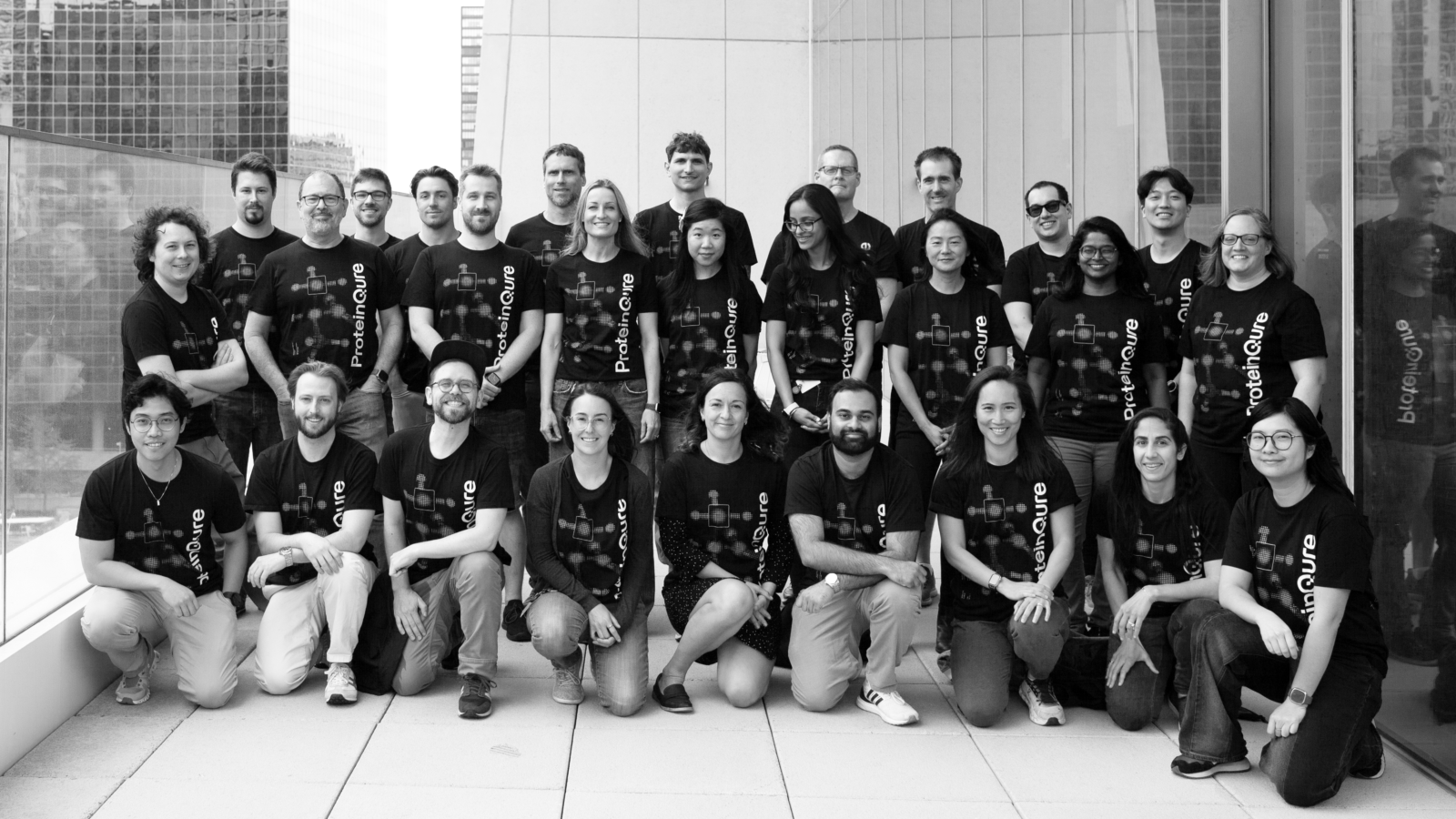
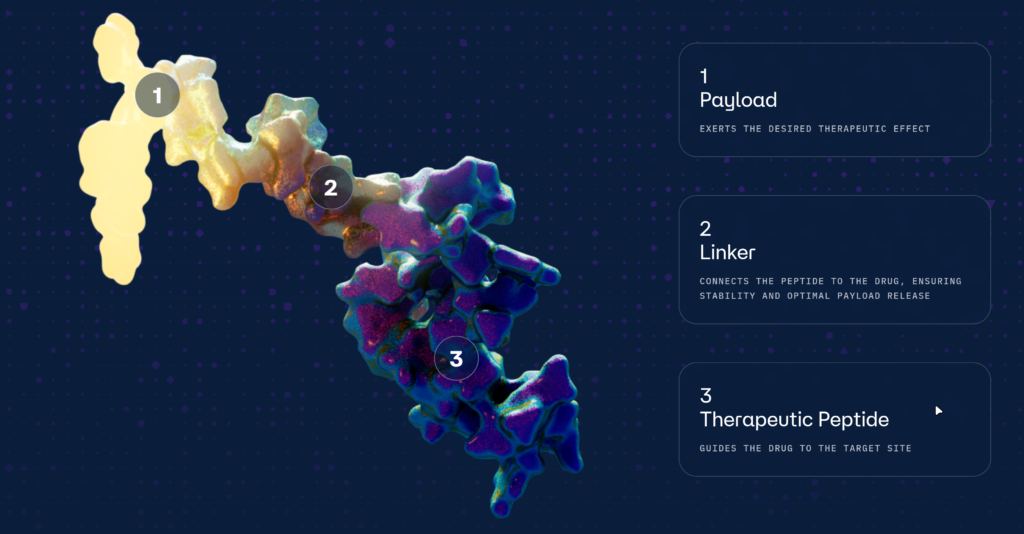
From CDL-Toronto’s 2017/18 cohort to leading a first-in-class clinical trial, ProteinQure has reached a defining milestone: the company’s AI-designed peptide therapy, PQ203, is now in Phase I clinical trials for advanced metastatic cancer, including triple-negative breast cancer. The compound has also received FDA Fast Track designation, a recognition reserved for therapies with the potential to address unmet medical needs.
The Toronto-based startup, which combines quantum physics, molecular simulations, and machine learning to design peptide therapeutics, first joined Creative Destruction Lab (CDL) in 2017 through the CDL Quantum stream. At the time, ProteinQure was one of the earliest AI drug discovery companies to emerge from the Canadian deep-tech ecosystem. Its founding team, including Tomas Babej, Mark Fingerhuth, Christopher Ing and Lucas Siow, was focused on building the computational infrastructure needed to make biologic drug design faster, more predictive, and less dependent on trial and error.
“The CDL course was critical for me to decide what I wanted to do,” recalls Siow, who joined ProteinQure’s founding team while completing his MBA at the University of Toronto’s Rotman School of Management. “Participating in CDL gave me two big pieces of information that I don’t think you could get without that type of experiential course. First, I got to see what being in a startup was actually like. Second, I was exposed to many startups, which meant when I joined one I had a lot more confidence in the quality of the team I was joining.”
During the CDL program, ProteinQure received mentorship and introductions that would shape the company’s early trajectory. The team was introduced to their first angel investor, Tom Williams, who has remained one of ProteinQure’s largest backers and led the company’s $11 million funding round earlier this year. Abe Heifets, former CEO of fellow CDL Alumni Atomwise, joined as an advisor in ProteinQure’s early years. And through Aaron Nelson, formerly atNovartis Venture Fund, the company was invited to meet with scientific teams at Novartis’ Boston research labs, an opportunity that deepened their understanding of how pharma organizations evaluate emerging technologies.
Now, several years later, the company’s progress represents a landmark moment for CDL’s community of science-based startups: ProteinQure is one of the first AI drug discovery companies emerging from CDL to reach human clinical trials.
Their lead candidate, PQ203, is being evaluated in collaboration with world-class cancer research centres across North America, including MD Anderson Cancer Center, Yale University, Princess Margaret Cancer Centre, and McGill University Health Centre. The Phase I trial aims to assess safety, tolerability, and early signals of efficacy for patients with advanced metastatic cancers.
“Working for large companies, it takes a long time to rise to the level that you can have the individual impact that you can have in a smaller organization,” Siow said. “At ProteinQure, I got to work with a world-class team on an extremely interesting problem: drug discovery, and in a space where the impact of success would just be massive.”
With its AI-driven design engine now validated in the clinic, ProteinQure’s story stands as a model of how scientific ambition, computational innovation, and mentorship networks can accelerate the path from algorithm to impact.